
Small-plate menus are appearing in restaurants more and more often as a response to changing guest behavior. The desire to try, share and order several smaller items instead of one large dish has become a natural part of many gastronomic concepts. In practice, however, a small-plate menu is not only a way of serving food. It is a decision that affects the restaurant’s margin, the pace of kitchen work, the workload of the dishwashing area, the organization of the dining room and the choice of gastronomic porcelain.
A small-plate menu in gastronomy is a service model in which the guest orders several smaller dishes, plates or sharing items instead of one classic main-course portion. This format can increase the average bill value, but only when the restaurant has properly calculated dish rotation, plate stock and an efficient team workflow.
In short: a restaurant working with a small-plate menu should usually have at least 2.5-3 pieces of each basic dish per seat, and in the case of high rotation of small plates, even 3-4 pieces per seat. It is also worth adding a 10-15% reserve for chips, delays in the dishwashing area, full occupancy and seasonal sales increases.
This is important because the question “how many plates should I buy for a restaurant?” should not be calculated only based on the number of seats. In a restaurant with a sharing menu, what also matters is the number of servings per guest, the speed at which dishes return from the dishwashing area, and how many different plate formats are working on the table at the same time.
At Fine Dine, we look at tableware not as decoration, but as a tool for everyday service. Well-chosen gastronomic porcelain should support the restaurant’s rhythm, showcase the food, withstand intensive use and, after many months, still look consistent with the character of the venue.
A small-plate menu as a system-level decision
Introducing a sharing menu affects many areas of the restaurant at the same time. The rhythm of orders, the frequency of serving dishes and the way guests use the table all change. There are more plates, more rotation and more moments of contact between the team and the guest.
It is not only about smaller portions. It is about the fact that the order is spread across several choices. Guests are more likely to return to the menu, add more small plates, order additional items for the center of the table and naturally build a higher bill. A small-plate menu can therefore support margin, but only when the kitchen, dining room and dishwashing area are prepared for a larger number of dishes in circulation.
A small-plate menu does not work separately from the rest of the restaurant. It requires consistent decisions regarding portion size, order of service, dishwashing capacity, the number of plates needed at the start and the choice of gastronomic porcelain that can withstand an intensive working rhythm.
Without this, instead of improving sales, a small-plate menu can create chaos. The kitchen starts waiting for plates, waiters look for clean dishes, the dishwashing area works under pressure, and the guest experiences a drop in the pace of service.
How many plates should you buy for a restaurant with a small-plate menu?
In a restaurant with a classic dish structure, the number of plates can be calculated more simply: seats, basic types of dishes and a reserve. With a small-plate menu, a larger safety margin is needed because one guest uses more dishes during one visit.
A safe starting point for a restaurant with a small-plate menu is 2.5-3 plates of a given type per seat, and for sharing plates and bowls even 3-4 pieces per seat. This means that a 60-seat venue should usually plan around 150-180 pieces of basic plates of a given type, as well as a larger reserve of the elements that rotate the fastest.
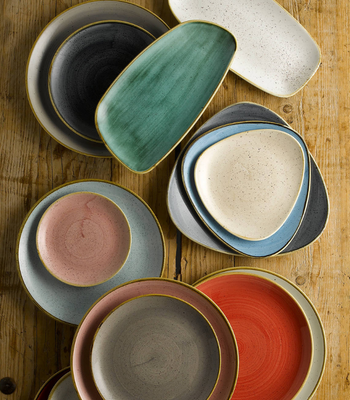
In practice, a starter set of gastronomic porcelain for a small-plate menu should include not only flat, deep and dessert plates, but also small sharing plates, bowls, rimmed plates, platters and accent pieces for starters, sauces and sides.
The most common mistake when buying porcelain for a restaurant is counting only the number of seats, not the number of plates used by one guest during the entire visit. With a sharing menu, one guest may use several dishes, and one table can generate more than a dozen elements for the dishwashing area in a short time.
That is why the question “how much porcelain does a restaurant need?” should be asked more precisely: how much porcelain does a restaurant need for a specific service model, a specific menu and a specific guest rotation?
The role of tableware in a sharing menu
With a small-plate menu, tableware stops being a neutral background. It becomes a work tool. It must withstand intensive rotation, frequent additions, quick washing and a variety of forms. At the same time, it should not dominate the food or create visual confusion on the table.
Well-chosen gastronomic porcelain helps organize the guest experience. Small plates, bowls, rimmed plates and platters guide the eye across the table, make sharing food easier and allow the kitchen to build the rhythm of service. In a small-plate menu, the plate is part of the sales scenario, not just a surface for serving a dish.
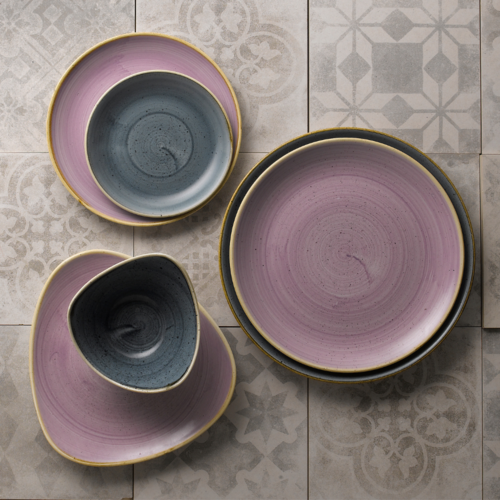
Colorful porcelain collections can serve a very specific function in this context. Instead of creating chaos, they help distinguish dishes, emphasize the character of the cuisine and create a coherent table composition. Different colors and forms make sharing easier, intuitively guide guests through the order and support the idea of eating together.
At Fine Dine, such solutions should be evaluated not only through the lens of an Instagram photo, but above all by how they behave in real service. Collections and lines such as Dahlia, Arando and Vibe can support different types of concepts: from premium-casual restaurants, through modern pubs, to venues based on starters, small plates and food for sharing.
Small-plate menus, the dishwashing area, time and margin
A sharing menu works when, after months of intensive operation, it still improves service rather than complicating it. This applies both to kitchen organization and to tableware, which goes through dozens of cycles of use, washing and carrying every day.
Too few plates cause downtime. The kitchen waits for the dishwashing area, service staff look for dishes, and the pace of service drops. Too many randomly selected porcelain pieces take up storage space, make table setup more difficult and generate unnecessary cost.
The best purchasing decision in gastronomy is one that combines the number of seats, dish rotation, dishwashing capacity, a reserve for losses and a coherent look of the dining room. Gastronomic porcelain should be calculated not only as an opening cost for the venue, but as an element that affects the smoothness of the team’s work and the repeatability of the guest experience.
With a small-plate menu, margin does not depend only on dish prices. It also depends on whether the restaurant can quickly serve the next items, maintain the pace of service, rotate tables efficiently and avoid downtime caused by a lack of clean dishes.
A good decision is one that still looks like a good decision after a year: operationally, visually and financially.
How does Fine Dine help choose porcelain for a small-plate menu?
When choosing porcelain at Fine Dine, it is worth starting with four questions:
how many seats does the restaurant have,
what dishes dominate the menu,
will guests be sharing food
and how intensively does the dishwashing area operate.
Only then should the choice of color, texture and collection come in.
For a restaurant with a small-plate menu, the starter set should include flat plates, deep plates, dessert plates, bowls, small sharing plates, platters and accent pieces. In premium-casual venues, modern pubs and à la carte restaurants, it is important that the tableware does not look banquet-like, but remains durable, repeatable and practical in everyday service.
Fine Dine helps you look at gastronomic porcelain as part of the restaurant system. A different set will work in a café with cakes and cups, another in a pub with burgers, fries and steaks, and another in a restaurant that builds the experience around several small plates placed in the center of the table.
That is why gastronomic porcelain is worth choosing not only with your eyes. Good tableware should work together with the menu, the team, the dishwashing area and the rhythm of the restaurant. In a small-plate menu, the plate affects not only the appearance of the dish, but also the pace of work, service comfort and the real profitability of service.
FAQ - short answers
- How many plates should you buy for a restaurant with a small-plate menu?
At the start, it is worth assuming a minimum of 2.5-3 pieces of basic dishware per seat, and for sharing plates and fast-rotating bowls, 3-4 pieces per seat.
- How much porcelain should a restaurant buy at the start?
The porcelain stock should result from the number of seats, the number of dishes ordered by one guest, dishwashing capacity and the pace of service. It is worth adding a 10-15% reserve for losses and delays in the circulation of dishes.
- Why does a small-plate menu affect the dishwashing area?
Because one guest uses more dishes during one visit. More small dishes mean more plates, bowls and platters that must quickly return to circulation.
- What gastronomic porcelain works well with a sharing menu?
Durable, repeatable porcelain that is easy to restock and available in many formats works best: flat plates, deep plates, rimmed plates, bowls, platters and small plates.
- Why is Fine Dine a good fit for restaurants with a small-plate menu?
Fine Dine offers tableware that can be selected systemically: according to the number of seats, the style of cuisine, the team’s workflow, the intensity of the dishwashing area and the way guests share food at the table.