
Colourful tableware for restaurants (455)
Colourful tableware for the catering industry enables chefs, restaurant owners and hoteliers to consciously create the visual presentation of dishes and the character of the entire table setting. Black, blue, green, brown, beige, pink, cream and multicoloured plates, bowls, serving platters, cups and serving dishes can provide a subtle backdrop for a dish or become a striking element of the presentation. A carefully chosen colour helps to highlight ingredients, contrasts, the seasonality of the menu and the restaurant’s individual style.
At Fine Dine, you’ll find an extensive range of colourful professional tableware from brands such as Fine Dine, Porland and Churchill. Colour categories include, amongst others, black, white, greys, browns, shades of blue, green, cream, beige, pink, red, orange and yellow. This means that tableware can be selected not only by the type of dish, but also according to a specific colour palette that complements the menu, the interior and the plating style.
Colourful tableware as a tool for professional plating
In professional catering, a plate is not merely a vessel. It serves as the surface upon which the head chef constructs the final composition of the dish.
The colour, shape, texture and proportions of the plate can emphasise specific ingredients or deliberately serve as a neutral backdrop for them.
Plate colour and the perception of the dish
The colour of the tableware affects the contrast between the food and the surface of the plate. Light-coloured ingredients may stand out more sharply against a dark background, whilst brightly coloured vegetables, fruit or sauces may create a completely different composition on a blue, green or beige plate.
Fine Dine also emphasises in its materials on plating that the colour of the plate influences the visual perception of the dish, and that it is worth testing the choice of tableware in practice with a specific dish beforehand.
The plate as a backdrop for the dish
A head chef can treat the plate like a photographic background: some colours soften the composition, whilst others enhance its contrast.
That is why it is best to select the plate whilst designing the dish’s presentation, rather than only after the recipe has been finalised.
Colourful tableware for restaurants
An à la carte restaurant can build its visual identity around a single collection or combine several colours depending on the type of dish.
Colourful tableware allows you to move away from the classic model, in which every dish is served on an identical white plate.
Colourful tableware for fine dining
In fine dining, colour can be part of a dish’s narrative. Green may correspond to plant-based and seasonal cuisine, dark tones to rich meat-based dishes, and softer shades to desserts or delicate starters.
However, such combinations should not be treated as a rigid rule. The best results are achieved by testing the actual plating on several surfaces.
Colourful tableware for hotels
A hotel can use colourful collections in its restaurant, lobby bar, room service, breakfast area and during banquets.
It is also possible to distinguish between different dining concepts by colour, whilst maintaining a consistent standard of quality.
Colourful tableware for catering and events
In catering, tableware has a significant impact on how the service is presented in various event spaces.
Colourful tableware can help tailor the table setting to the character of a wedding, gala, conference, themed dinner or corporate event.
Black tableware
Black plates and bowls create a strong contrast and can highlight light-coloured sauces, vegetables, fish, desserts and more minimalist plating.
In the current FineDine range, black is one of the main colour categories for tableware.
Black plates for a modern restaurant
Black works well with industrial, minimalist and more theatrical interiors.
When serving a vibrantly coloured dish, it helps to create a clear boundary between the food and the surface of the plate.
White tableware
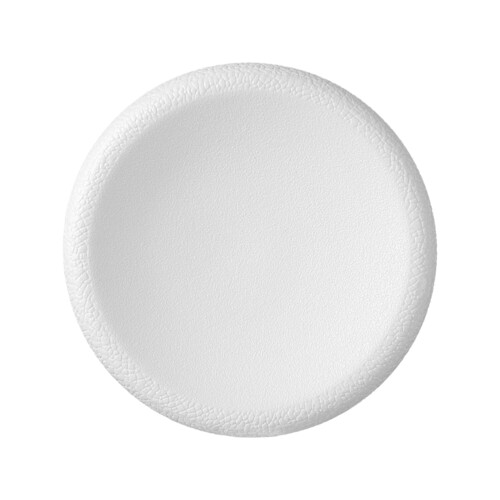
White tableware remains a classic backdrop for the catering industry and need not be the antithesis of a colour category. On FineDine.pl, it is one of the fully valid options when filtering tableware by colour.
White brings out the natural colours of ingredients well and is suitable for both banquets and fine dining.
Cream-coloured tableware
A cream shade is a warmer alternative to cool white. It can give a table setting a softer, more natural feel.
FineDine currently has extensive collections in this colour scheme, including the new Pure Crema pieces, which can be viewed directly in the colours category. :contentReference[oaicite:2]{index=2}
Beige tableware
Beige plates fit well into restaurants inspired by nature, minimalism and materials in warm colour schemes.
They can provide a calm backdrop for seasonal cuisine, bread, root vegetables, fish and many contemporary dishes.
Brown tableware
Brown can evoke associations with the earth, wood, smoky aromas and a more rustic aesthetic.
It works well with meat, mushrooms, fermented produce, chocolate desserts and cuisine inspired by the autumn season.
Grey tableware
A grey plate is more neutral than black, but offers greater contrast than classic white.
It suits industrial and modern restaurants well, as well as compositions where the colour of the ingredients is meant to remain the most important element.
Blue tableware
Blue plates can create a fresh, distinctive backdrop for seafood, fish, vegetables and many colourful compositions.
Churchill highlights blue and deeper shades of blue as an essential palette for professional tableware, particularly when presenting fresh ingredients. :contentReference[oaicite:3]{index=3}
Blue plates for fish and seafood
Fine Dine demonstrates a similar approach in its training materials on plating. One example is the pairing of tuna tartare with a blue Lazur plate, whose colour creates a visual association with the sea. :contentReference[oaicite:4]{index=4}
This does not mean that blue tableware should be limited solely to fish — its possibilities are much broader.
Green tableware
Green plates can evoke associations with herbs, plants, gardens and seasonality.
They work well in restaurants specialising in plant-based cuisine, local produce and nature-inspired concepts.
Green tableware for plant-based cuisine
The colour can support the narrative of the dish, but it should not dominate the food itself.
It’s worth pairing several shades of green with the actual dish, as light Sage, intense Sorrel or the rich greens of Fine Dine will produce completely different results.
Churchill Stonecast in shades of green
Churchill is developing professional Stonecast collections in colours such as Sage Green and Sorrel Green. Individual decorations are handcrafted, which means there are natural variations between pieces. :contentReference[oaicite:5]{index=5}
This variation should be regarded as a characteristic of a specific series, rather than a universal feature of all coloured tableware.
Pink tableware
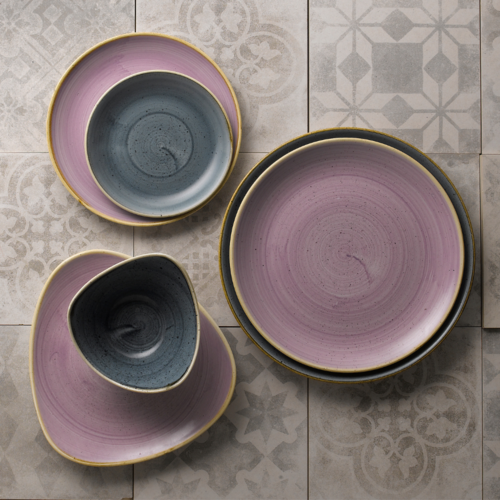
Pink plates and bowls can create a soft, modern backdrop for desserts, breakfasts, starters and contemporary casual dining.
FineDine.pl classifies pink as a distinct colour group, and its portfolio of catering brands features both delicate and more saturated versions of this colour. :contentReference[oaicite:6]{index=6}
Orange and rust-coloured tableware
Orange, terracotta and rust may be associated with fire, spices, baking, autumn and natural materials.
Churchill uses similar tones in professional palettes such as Warm Patinas, combining them with black, grey and metallic accents. :contentReference[oaicite:7]{index=7}
Yellow tableware
Yellow can bring energy and contrast to the table. It works particularly well as a single accent or as part of a more elaborate mix-and-match scheme.
With such a vibrant colour, it’s worth checking beforehand whether the surface competes visually with the most colourful elements of the dish.
Red tableware
Red is one of the boldest colours for tableware. It can be used to create striking accents or to establish a restaurant’s distinct identity.
It features as one of the main colour categories in the FineDine range, whilst Porland is also developing Seasons variants in shades of red. :contentReference[oaicite:8]{index=8}
Fine Dine’s colourful tableware
The Fine Dine brand makes up the largest part of the current colour range. The website currently features 357 products from this manufacturer, alongside 50 from Porland and 49 from Churchill. :contentReference[oaicite:9]{index=9}
The range includes numerous à la carte collections, such as Aurum, Edenic, Rosa, Fiord, Fizz, Selene, Aura & Vibe, Mia, Galaxy, Dahlia, Arando, Lazur, Onyx, Beryl, Vanilla, Flora, Crust, Nordic and Topaz. :contentReference[oaicite:10]{index=10}
Fine Dine Earth Colours and nature-inspired tableware
In many Fine Dine collections, colour is not merely a flat print, but an integral part of the tableware’s overall design — alongside its texture, rim and tonal gradients.
This means individual ranges can be used in a restaurant’s mix-and-match scheme or to keep the entire table within a single colour palette.
Porland Seasons – colourful catering tableware
Porland Seasons is one of the key examples of professional tableware based on colour. FineDine currently offers, amongst others, Seasons Sand, Ashen, Stone, Laguna, Coal, Amber and Magma. :contentReference[oaicite:11]{index=11}
It offers a wide palette ranging from calm earth tones to bolder colours, making it easier to match the collection to the character of a specific concept.
Churchill Stonecast – colour for professional tableware
Churchill Stonecast is an extensive range of professional tableware available in a variety of colours and finishes. The current FineDine range includes, amongst others, Barley White, Duck Egg Blue, Petal Pink, Sorrel Green and Peppercorn Grey. :contentReference[oaicite:12]{index=12}
The manufacturer has developed Stonecast specifically with various hospitality settings in mind, and many of the decorations are handcrafted. :contentReference[oaicite:13]{index=13}
Colourful catering plates
Colourful plates are the most important part of this category from a plating perspective. You can choose between flat plates, deep plates, coupe plates, gourmet plates, plates for pasta, pizza and desserts, as well as more artistic designs.
FineDine’s current range includes, amongst others, coloured plates from the Fiord, Fizz, Onyx and Sand collections, as well as numerous variants from the Porland and Churchill collections. :contentReference[oaicite:14]{index=14}
Colourful catering bowls
These bowls can be used for soups, ramen, poke bowls, salads, starters, breakfast dishes and desserts.
The colour of the bowl’s interior is particularly visible in these formats and can have a significant impact on the final presentation.
Colourful deep plates
A deep plate allows you to build a composition in the centre of the dish and work with sauces, broths and more spacious plating.
The colour of the wide rim can also create a visual frame around the dish.
Colourful pasta tableware
Pasta plates can make good use of the contrast between the sauce, the pasta and the surface of the plate.
With creamy sauces, it is worth experimenting with darker or more intense backgrounds, whilst dishes with very rich colours may look good against more subdued colours.
Colourful tableware for sushi
Sushi offers particularly extensive opportunities for working with colour, as the light-coloured rice, dark nori, fish, vegetables and garnishes create many natural contrasts.
In its guidance on serving sushi, Fine Dine also highlights the use of rich colours and the possibility of creating either cohesive or mixed sets of tableware. :contentReference[oaicite:15]{index=15}
Colourful dessert tableware
Desserts offer particular freedom to use pink, blue, black, green or warmer tones.
When making a selection, it is worth considering not only the colour of the dessert itself, but also that of the sauces, fruit, decorations and the space remaining on the plate.
Colourful tableware for steaks and meat
Dark greens, greys, browns and blacks can create an attractive backdrop for grilled and roasted dishes.
Fine Dine suggests, amongst others, the green shade Stonecast Sorrel Green as an example for steaks, but the final choice should always depend on the specific composition of the dish. :contentReference[oaicite:16]{index=16}
Colourful tableware for breakfast and brunch
Breakfasts and brunches naturally make use of the many colours of their ingredients: fruit, vegetables, eggs, bread, smoothie bowls and sweet pastries.
Pastel, cream and natural shades can lend a lighter feel to the table setting, whilst dark plates provide a stronger contrast.
Colourful tableware for cafés
In a café, colourful cups, saucers and bowls can form part of the venue’s visual identity.
It is worth maintaining consistency between the tableware used for coffee, desserts and any breakfast menu.
Colourful tableware for a buffet
Colour can also help to organise the buffet visually and highlight individual product groups.
When doing so, tableware should be chosen according to its actual purpose and the operating conditions of the specific buffet system.
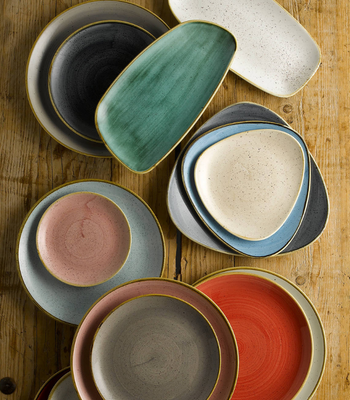
Mix & match colourful tableware
Mix & match allows you to combine different colours, shapes and collections within a single concept.
However, the best effect is achieved with a deliberately designed colour palette, rather than a random combination of all available colours.
How to combine plate colours?
You can base your choices on the harmony of earthy tones, a combination of contrasting colours, or a single colour in several shades.
With an extensive menu, it may also be a good idea to assign selected collections to specific groups of dishes.
One collection or several colours?
A single collection makes it easier to maintain a consistent style and to add to the tableware collection later on. Several colours, on the other hand, offer greater flexibility when plating.
A restaurant should choose a solution that suits the kitchen’s working methods and the frequency of menu changes.
Colourful tableware and seasonal menus
Changing the colour scheme of plates between seasons can help create a different atmosphere for the menu without having to completely overhaul the table setting.
In spring and summer, greens and blues can be used more prominently, whilst in autumn and winter, browns, deeper greens, greys or rust tones can be favoured — provided this fits with the restaurant’s aesthetic.
Colourful tableware and restaurant branding
Some restaurants treat a specific tableware colour as part of their own visual language.
A consistent colour palette can appear on the table, in menu photographs, on social media and in promotional materials, creating a more recognisable brand identity.
Colourful tableware and food photography
The same plate that works well at the table can also help create more consistent photographs for the menu and the restaurant’s communications.
However, it is worth checking how colours appear under the actual lighting in the dining room and in photographs.
Colour and the texture of tableware
The perception of a piece of tableware depends not only on its colour. A matt surface, gloss, speckled pattern, reactive finish or contrasting rim can completely change its character.
When making a selection, it is therefore worth analysing photographs and samples of the entire product, rather than just the colour name.
Hand-decoration and natural variations
In some professional collections, the colour and decoration are applied by hand. Churchill Stonecast is an example of a range where this finish results in natural variations between individual pieces. :contentReference[oaicite:17]{index=17}
However, this characteristic should not be assumed to apply to all products in the coloured tableware category.
Coloured porcelain and stoneware
The FineDine category includes tableware made from various materials. The shop’s range includes, amongst others, porcelain, stoneware and glass. :contentReference[oaicite:18]{index=18}
Therefore, I would not describe the entire page as ‘coloured porcelain’ — the broader term ‘coloured tableware’ is more precise.
How do you match the colour of a plate to a dish?
It is best to start with the dominant colours of the dish. Next, it is worth considering whether you need contrast, a neutral background or a deliberate extension of the colours of the ingredients.
Fine Dine recommends carrying out trial plating before making the final choice of new tableware, which is particularly sensible when purchasing a large number of items for a restaurant. :contentReference[oaicite:19]{index=19}
How to match the colour to the restaurant’s interior?
A table does not exist in isolation from its surroundings. The colour of the tableware should complement the tabletop, textiles, cutlery, glassware and lighting.
Darker and earthy colour palettes may work well in an industrial-style venue, whilst in a light, natural interior, beiges, creams, greens and softer shades are preferable.
How to match tableware to cutlery and glassware?
Colourful tableware is usually the strongest visual element of a table setting, so glassware and cutlery should form a deliberate composition with it.
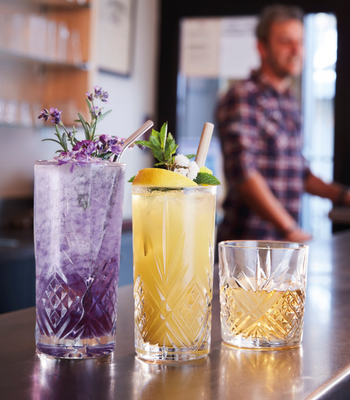
Neutral glassware can balance out striking plates, whilst decorative cutlery can further enhance the character of a more formal table.
How to choose colourful tableware for high-volume catering?
As well as appearance, you need to assess the diameter, height, weight, storage options, compatibility with equipment and care instructions.
Parameters such as durability, stackability, dishwasher safety, microwave suitability and temperature resistance should be checked for specific products, as this category encompasses many manufacturers, materials and technologies.
How many colours of tableware does a restaurant need?
There is no need to create a separate colour scheme for every dish. In many establishments, two or three well-chosen ranges are sufficient, as they can be used flexibly.
However, if the menu changes frequently, a wider range of colours may offer the head chef more options.
How should you put together a colourful tableware set?
A good starting point is the most frequently used dinner plates and soup plates, followed by bowls, smaller plates, serving platters and drinkware.
It is worth checking whether a particular collection offers a sufficient number of sizes to suit the restaurant’s actual menu.
Colourful tableware for new dining concepts
When opening a restaurant or changing its concept, the choice of tableware can form part of the overall design process.
It is worth matching the colour of the plates with the interior design, the menu and sample dishes before ordering the full quantity.
Colourful tableware for the home too
Colourful catering tableware can also be an interesting choice for individual customers who wish to bring a more creative way of serving food into their homes.
You can create a matching set or deliberately combine several colours inspired by professional mix-and-match styles.
Choose tableware by colour
FineDine now allows you to navigate directly to the categories of black, white, grey, red, brown, blue, cream, yellow, orange, green, beige, pink and multicoloured tableware.
This filtering allows you to start your selection with a colour palette and then narrow down the range by manufacturer, collection, material and type of tableware.
Fine Dine, Porland and Churchill – different approaches to colour
Fine Dine offers a very wide range of its own à la carte collections, Porland is developing, amongst others, the Seasons range, whilst Churchill is strongly represented by Stonecast and other professional hospitality ranges. :contentReference[oaicite:20]{index=20}
This means that colour can be chosen not only according to shade, but also according to the character of the decoration and the manufacturer’s design aesthetic.
Colourful tableware – from a neutral backdrop to a striking element of presentation
A beige or cream plate can subtly highlight natural ingredients, deep black can create a strong contrast, blue can evoke freshness, and green can enhance the natural character of the composition.
The most important thing is the conscious use of colour as part of the overall dish design.
Discover colourful tableware at Fine Dine
Choose colourful tableware for the catering industry suitable for restaurants, hotels, catering services, cafés, bars or professional events. Compare plates, bowls and tableware in various shades to find the backdrop that best complements your menu and plating style.
Combine the colour, shape, material and character of the collection to create a cohesive tableware set that suits both the day-to-day operations of a professional kitchen and the visual identity of your venue.