
Vacuum sealers and sous-vide circulators (1)
Vacuum sealers and sous-vide circulators are professional appliances that assist chefs in the preparation, portioning and controlled processing of food. A vacuum sealer allows you to place a properly prepared product in an airtight bag and remove the air from it, whilst a sous-vide circulator enables you to maintain a water bath at a precisely set temperature. This combination is used in restaurants, hotels, catering businesses, central kitchens and other professional catering establishments.
Sous-vide technology can be used with meat, fish, vegetables and many other products, provided it complies with the prescribed recipe and food safety procedures. Professional packaging machines are also useful independently of sous-vide – when portioning products, organising mise en place and sealing food for further storage in accordance with the establishment’s procedures.
Vacuum sealers and sous-vide equipment in a professional kitchen
In a well-organised professional kitchen, these appliances form a logical production flow: the prepared product is portioned, sealed, stored appropriately, and can then undergo controlled heat treatment.
This approach makes it easier for the head chef to plan production and standardise recipes, but requires adherence to the correct procedures regarding temperature, time, cooling and food storage.
Vacuum sealers for the catering industry
A vacuum sealer enables the product to be sealed in a suitable bag or packaging with the amount of air inside minimised.
In the catering industry, this technology can be used when preparing portions, organising back-of-house operations, preserving semi-finished products and preparing products for selected sous-vide techniques.
Vacuum sealers for head chefs
For a head chef, a vacuum sealer can primarily serve as a tool for organising production. Individual portions can be prepared to a specific weight and arranged in a system corresponding to the successive stages of mise en place.
In larger kitchens, this helps to separate the product preparation stage from the final service.
Vacuum sealer for mise en place
During mise en place, products can be portioned, labelled and prepared in accordance with the production plan for a specific section.
However, packaging alone does not replace the principles of proper refrigeration, labelling or checking use-by dates.
Chamber vacuum packers
A chamber vacuum packer carries out the process inside the machine’s chamber. This type of design is commonly used in professional catering for more regular product packaging.
Current HENDI models feature, amongst other things, high-performance oil pumps and are available in several chamber sizes and sealing bar lengths. :contentReference[oaicite:1]{index=1}
Seal bar packaging machines
Seal bar packaging machines are a more compact alternative to chamber designs. They may be suitable for premises carrying out fewer cycles or requiring a machine that takes up less space.
HENDI currently offers bar-type models with various specifications, including machines with a pulsed vacuum function designed for more delicate products. :contentReference[oaicite:2]{index=2}
Chamber or bar-type packaging machine?
The choice depends primarily on the intensity of operation, the type of products and the space available in the back-of-house.
A kitchen that regularly prepares large numbers of portions may prefer a chamber-type machine, whilst a small establishment may find a more compact bar-type packaging machine more suitable.
Packaging liquid products
Sauces, marinades and products containing a higher proportion of liquid require a specialised approach to packaging.
For such applications, it is important to check whether the design of the specific machine and the type of bag used are suitable for the product.
Packaging delicate products
Not all ingredients respond well to intensive air extraction. Delicate products may require a shorter cycle or more precise process control.
Selected packaging machines feature a pulsed operation mode specifically to allow the operator to better control the vacuum level. :contentReference[oaicite:3]{index=3}
Packaging restaurant portions
Products can be divided into portions corresponding to the standard weight of a dish and prepared before service begins.
This approach can facilitate work organisation, particularly if the establishment has clearly defined recipes and production procedures.
Vacuum-sealing bags
The type of bag must be suitable for the type of vacuum sealer used and the intended application.
Not every bag is suitable for heat treatment. For sous-vide cooking, choose packaging explicitly designated by the manufacturer for this purpose. HENDI offers separate sous-vide cooking bags designed for chamber vacuum sealers. :contentReference[oaicite:4]{index=4}
Sous-vide circulators
A sous-vide circulator heats and circulates the water in the tank, helping to maintain as uniform a bath temperature as possible.
This allows the chef to cook according to the specific combination of time and temperature specified in the recipe.
Immersion circulators for the catering industry
Immersion models can be installed in a suitable tank, allowing the system to be adapted to the required production volume.
HENDI currently offers professional circulators designed, amongst other things, for 30, 50 and 80-litre tanks, as well as the more powerful MASTERVIDE model, which accommodates up to 56 litres. :contentReference[oaicite:5]{index=5}
Precise sous-vide temperature control
One of the key distinguishing features of this technology is the ability to control the temperature much more accurately than with many traditional cooking methods.
For example, the current HENDI MASTERVIDE allows the temperature to be set and maintained with an accuracy, as stated by the manufacturer, of 0.1°C up to 95°C. :contentReference[oaicite:6]{index=6}
Hamilton Beach Commercial AcuVide
FineDine also stocks the Hamilton Beach Commercial AcuVide 1000, designed for commercial and catering kitchens. :contentReference[oaicite:7]{index=7}
FineDine points out that the AcuVide can be used in conjunction with PrimaVac chamber vacuum sealers as part of a complete professional sous-vide system. :contentReference[oaicite:8]{index=8}
Sous-vide for chefs
This technique allows for the very precise specification of cooking parameters and the repetition of the same procedure for subsequent portions.
This is particularly useful in kitchens where standardising the degree of food preparation is important, as well as the ability to separate part of the production process from the final finishing touches before serving.
Sous-vide for meat
Meat is one of the products most commonly associated with the sous-vide technique. Controlled temperature can be applied prior to final searing, grilling or other finishing methods.
However, the time and temperature settings must be determined by the type of meat, its thickness, the recipe and applicable food safety procedures.
Sous-vide for steaks
For steaks, sous-vide can be used for initial controlled cooking, after which the product is quickly finished on a very hot surface.
The technique requires careful planning of the entire process – from packaging through cooking to the final serving.
Sous-vide for poultry
Poultry can be prepared using the sous-vide method, but for reasons of microbiological safety, it is particularly important to select the correct process parameters.
One should not rely solely on a visual assessment of the product, nor treat a universal temperature as suitable for all recipes.
Sous-vide for fish
The delicate texture of fish means that precise temperature control can be particularly useful for certain recipes.
Here too, the parameters should be determined in accordance with the specific product and the kitchen’s established procedures.
Sous-vide for vegetables
The technique is not intended solely for meat products. It can also be used for selected vegetables and other plant-based ingredients.
A chef can utilise this controlled process to achieve a specific texture or to organise production in advance.
Sous-vide for fruit
In certain recipes, a similar approach can also be applied to fruit, particularly when controlled temperature is part of the planned culinary technique.
However, not every product requires vacuum packing or prolonged cooking, so the technique should only be used where it produces a specific result.
Sous-vide for sauces and menu items
Selected components of a dish can also be prepared in bags designed for this purpose, provided this is in line with the recipe and the product’s characteristics.
Packaging can facilitate the organisation of several pre-prepared elements prior to serving.
Consistency in the kitchen thanks to sous-vide
A well-defined recipe allows the team to replicate specific time and temperature parameters.
A circulator does not replace the chef’s experience, but it can reduce some of the variability associated with manually controlling the heat source.
Sous-vide in fine dining
In a fine dining restaurant, the technique can be one of many tools used by the chef to achieve a specific texture and organise production.
It does not need to be visible to the guest – what matters most is the result and how the product is used in the final dish.
Sous-vide in à la carte restaurants
In à la carte settings, part of the preparation can be carried out before the peak service period begins, with the dish finalised once the order is received.
However, such a system requires carefully planned logistics, cooling, storage and identification of individual portions.
Sous-vide in hotels
A hotel may use the equipment in its restaurant, for banquets and in selected central kitchen processes.
When preparing a larger number of portions, it becomes particularly important to match the capacity of the packaging machine and the bath to the actual scale of operations.
Sous-vide in catering
In catering, the technique can help separate preparation from the final finishing touches carried out at the event venue.
However, the entire process must take into account proper cooling, transport and subsequent reheating in accordance with established safety procedures.
Vacuum packers in central kitchens
Kitchens preparing food for several outlets can use vacuum packing to standardise portion sizes and organise distribution.
On a larger scale, the pump’s capacity, the chamber size and the duration of a single cycle are particularly important.
Packaging machines in catering
A packaging machine can be used for the advance preparation of semi-finished products and portions to be used during an event.
However, vacuum sealing of a product should not be equated with an automatic extension of its safe storage life.
Vacuum packaging and food storage
Restricting air access may affect the product’s storage conditions, but does not eliminate microbiological risk.
In professional catering, appropriate temperatures, use-by dates and HACCP procedures specific to the food in question must still be followed.
Vacuum packing and HACCP
A vacuum sealer is a piece of equipment, not a food safety system in itself.
Procedures should specify, amongst other things, how the product is prepared, its labelling, refrigeration conditions and further handling prior to service.
Sous-vide and food safety
Precise temperature control is one of the advantages of a circulator, but safety depends on the overall combination of time, temperature, product type, its initial condition and subsequent handling.
A professional establishment should have verified procedures for recipes prepared using this method.
Cooling after sous-vide
If the product is not served immediately after cooking, the method of its subsequent cooling is an essential part of the production process.
The finished product should not be left without temperature monitoring simply because it is in a sealed bag.
Regeneration of sous-vide products
In a planned production system, a pre-prepared product can subsequently undergo controlled regeneration and final finishing.
The parameters for this stage should also be part of the recorded recipe, rather than being determined arbitrarily during service.
The packaging machine and circulator as a single system
Combining both devices makes the most sense when the process is designed as a whole.
Portioning → packaging → controlled processing → cooling (if required) → storage → regeneration or final finishing → service forms a structured workflow for a professional kitchen.
How to choose a vacuum packaging machine?
The most important factors are the type of machine, pump capacity, chamber size or maximum bag width, the length of the sealing bar, and the planned number of cycles.
A restaurant packaging a few products a day will have different requirements to a central production facility carrying out several dozen cycles.
How do you choose the right chamber size?
The chamber must accommodate the standard portions and bags used on the premises.
Before purchasing, it is worth measuring the largest product packed on a regular basis, rather than selecting a machine based solely on its external dimensions.
How do you choose the length of the sealing bar?
The length of the sealing bar determines the maximum width of the packaging that can be sealed correctly.
The current range of HENDI catering packaging machines features sealing bars of various lengths and machines of different sizes, allowing you to match the model to your production scale. :contentReference[oaicite:9]{index=9}
How to choose a sous-vide circulator?
The most important parameters are power, water capacity, temperature control range and precision, and the method of mounting the unit.
In a larger kitchen, the rate at which the bath heats up and the actual quantity of products placed in the tank at any one time are also important.
How to choose the right power for a circulator?
A larger tank and a greater weight of products require a sufficiently powerful heating system and effective circulation.
For example, modern HENDI models range from 1,200 W for a 30-litre system to 2,300 W for an 80-litre model, whilst the exact specifications should be selected to suit the specific production setup. :contentReference[oaicite:10]{index=10}
Which tank should be used with a circulator?
The tank must meet the circulator manufacturer’s requirements and be suitable for the size of the batch being prepared.
Products should be arranged in such a way as to allow water to circulate freely, rather than forming a tightly packed mass that blocks circulation.
Lid for a sous-vide tank
During longer processes, a suitably chosen lid can reduce water evaporation and heat loss.
However, you should use a solution that is compatible with your specific tank and circulator.
How to set up a sous-vide workstation?
The equipment should be positioned on a stable workstation, with adequate access to a power supply and the ability to handle hot water safely.
You should also plan the product’s route before and after processing to minimise unnecessary movement of bags between zones.
How do you clean a vacuum sealer?
The chamber, sealing bar and work surfaces should be maintained in accordance with the manufacturer’s instructions.
Spilled liquids and food residues should be removed regularly, particularly on machines that are in heavy use throughout the production day.
How do you clean a sous-vide circulator?
Contact with hot water can lead to the build-up of mineral deposits over time.
For example, the AcuVide 1000 available from FineDine features a cleaning cycle and a reminder to remove deposits, designed to support the proper operation of the circulation pump. :contentReference[oaicite:11]{index=11}
Vacuum sealers and circulators for small restaurants
A smaller establishment does not always need the largest chamber machine or a circulator with very high capacity.
A better solution may be a compact system tailored to a few key recipes and the actual number of portions being prepared.
Vacuum sealers and circulators for large-scale catering
In hotels, central kitchens and larger restaurants, throughput and the ability to process larger batches of food simultaneously are of paramount importance.
In such conditions, it is worth considering not only the price of the equipment, but also the cycle time and how well the equipment fits into the overall production plan.
Sous-vide for home users too
Vacuum sealers and smaller circulators can also be used at home by those interested in more precise cooking techniques.
However, just as in the catering industry, you must use the correct bags and follow the safety guidelines specific to the product being prepared.
Professional sous-vide kit
A complete system may include a vacuum sealer, suitable cooking bags, a circulator, an appropriate container and the equipment needed for further cooling or the final finishing of the product.
By selecting equipment as a single integrated process, it is easier to create a workstation that matches the actual production scale of the kitchen.
Discover vacuum sealers and sous-vide circulators at Fine Dine
Choose vacuum sealers and sous-vide circulators suited to restaurants, hotels, catering businesses or professional kitchens. Carefully selected equipment helps organise portioning, mise en place and the controlled preparation of ingredients according to set recipes.
Compare the type of sealer, chamber size, pump specifications, sealing bar length, and the power and capacity of the circulator to build a system tailored to your menu, production volume and the kitchen team’s working methods.
BarFly by Mercer Culinary is a range of professional bar accessories designed for preparing cocktails in cocktail bars, restaurants, hotels, clubs and other catering establishments. The range includes, amongst other items, cocktail shakers, jiggers, spoons, Hawthorne and fine-mesh strainers, mixing glasses, muddlers, bottle openers, graters, garnish tools and complete bartending sets. An extensive selection of sizes and finishes allows the equipment to be adapted to both intensive professional use and the visual style of a particular bar.
BarFly accessories form part of the Mercer Culinary portfolio. The manufacturer is developing this range for professional bartenders and mixology enthusiasts, emphasising durability, precision, control and consistency when preparing cocktails. The tools cover every stage of the process – from measuring and preparing ingredients, through shaking and stirring, to straining, garnishing and the final presentation of the drink. :contentReference[oaicite:2]{index=2}
BarFly Mercer Culinary – professional bar equipment
BarFly is a specialist barware range developed by Mercer Culinary. The brand focuses on the tools needed in the day-to-day work of a professional bartender – from basic shakers and measuring cups to more specialised strainers, glasses and accessories for preparing garnishes. :contentReference[oaicite:3]{index=3}
This allows the bar station to be kitted out as a cohesive system, rather than selecting random tools of varying proportions, functions and styles.
BarFly bar accessories for the professional catering industry
Professional bar accessories should be tailored to the establishment’s operating style and actual cocktail menu. A classic hotel bar requires a different set to a cocktail bar serving a large number of signature recipes, and yet another to a restaurant preparing just a few basic cocktails.
FineDine currently offers a very wide range of BarFly products, comprising around 98 items across many categories of bar equipment. :contentReference[oaicite:4]{index=4}
BarFly shakers
A bar shaker is the essential tool for preparing cocktails that require the ingredients to be thoroughly mixed with ice.
BarFly offers various shaker designs, ranging from classic Boston-style systems to multi-piece cobbler-style models and more decorative variants inspired by Japanese barware. FineDine currently showcases, amongst others, the three-piece BarFly Diamond Lattice shakers. :contentReference[oaicite:5]{index=5}
BarFly Boston shaker
The Boston shaker is a popular choice in professional cocktail bars due to its simple design and efficiency.
When choosing, it is worth paying attention to how well the parts fit together, the capacity and how easy it is to open once shaking is complete.
BarFly three-piece shakers
A three-piece shaker combines the body, strainer and lid in a single set.
It may suit bartenders who prefer a more compact system, whilst BarFly’s decorative models also allow the tool to be matched to the style of the bar.
BarFly jiggers
The BarFly jigger allows you to measure out spirits, juices, syrups and other recipe ingredients.
FineDine currently offers, amongst others, 20/40 ml and 25/50 ml models, as well as 30/60 ml Japanese-style jiggers. Such a variety of capacities allows the tool to be adapted to the recipe standards used in a particular bar. :contentReference[oaicite:6]{index=6}
Precise measurement of cocktail ingredients
Consistency is one of the fundamental requirements of professional mixology. The same cocktail should maintain similar proportions regardless of which barman is working during a particular shift.
Mercer Barfly highlights precision and control as key principles of its barware range. :contentReference[oaicite:7]{index=7}
Japanese-style jiggers
The Japanese jigger features a slender, elongated shape and may be well-suited to workstations designed for precise, rhythmic working methods.
FineDine currently offers, amongst other items, BarFly Diamond Lattice jiggers with capacities of 30/60 ml. :contentReference[oaicite:8]{index=8}
BarFly bar spoons
A bar spoon is primarily used for stirring cocktails in a mixing glass, but can also assist with layered pouring and controlling small quantities of ingredients.
FineDine offers BarFly spoons in various lengths, including classic spoons of approximately 315 mm and longer 400 mm models. :contentReference[oaicite:9]{index=9}
Long stirring spoons
The longer handle makes it easier to work in a tall glass and allows the bartender to perform a smooth stirring motion around the ice.
The choice of length should match the glass and the technique used by the team.
Stirred cocktails with BarFly accessories
Manhattans, Martinis, Negronis, Boulevardiers or Old Fashioneds may require a stirring technique rather than vigorous shaking, depending on the recipe.
For such drinks, a system comprising a mixing glass, a suitable spoon and a strainer is essential.
BarFly mixing glasses
A mixing glass is used to stir cocktails with ice and to control the cooling and dilution of the drink.
FineDine currently offers BarFly in sizes including approximately 500 ml, as well as the decorative Diamond Lattice double-walled mixing glass with a capacity of 621 ml. :contentReference[oaicite:10]{index=10}
Mixing glass for a professional bar
When choosing a mixing glass, it is worth considering the capacity, the amount of ice used and the size of a standard batch.
A larger model may be useful when preparing several portions, whilst a smaller one offers better control when making a single cocktail.
Coloured BarFly mixing glasses
BarFly also uses colour and decorative finishes as a means of identifying its barware. The current FineDine range includes, amongst others, mixing glasses in gold, pink and blue. :contentReference[oaicite:11]{index=11}
Such tools can serve both as functional equipment and as a prominent feature of the bar’s décor.
BarFly cocktail strainers
A cocktail strainer separates the finished cocktail from ice and larger particles of ingredients when pouring into a glass.
BarFly offers various designs, allowing you to choose the filtering method to suit your shaker, glass and recipe.
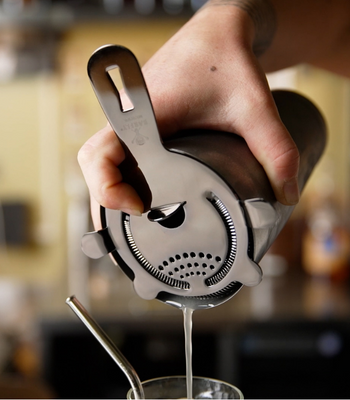
BarFly Hawthorne strainers
The Hawthorne strainer features a distinctive spring and is one of the essential tools in a professional cocktail bar.
FineDine currently offers an 184 mm BarFly model in a stainless steel version and with black, copper, gold and antique copper finishes. :contentReference[oaicite:12]{index=12}
BarFly fine mesh strainer
The fine mesh strainer enables more precise filtering of fine particles of ice, fruit, herbs and other ingredients.
FineDine currently offers both the classic BarFly conical strainers and the 2-in-1 mesh model. :contentReference[oaicite:13]{index=13}
Double strain in a professional cocktail bar
With the double strain technique, the cocktail passes through two stages of filtration, which helps to minimise the amount of fine particles ending up in the glass.
Combining a Hawthorne strainer with a fine-mesh strainer gives the bartender greater control over the final texture of the drink.
BarFly muddlers
A muddler is used to crush herbs, fruit and other ingredients directly in the glass.
FineDine describes BarFly muddlers as tools for extracting flavour and aroma from ingredients whilst preparing cocktails. :contentReference[oaicite:14]{index=14}
Muddler for Mojitos and herbal cocktails
When working with mint, citrus fruits and other fresh ingredients, controlling the pressure is crucial. Excessive crushing can lead to undesirable changes in texture or flavour.
A good muddler should allow you to work precisely and comfortably within the glassware you are using.
BarFly bar graters
A bar grater can be used for nutmeg, chocolate, spices or citrus zest to add an aromatic finish to a cocktail.
FineDine currently offers, amongst other items, a 254 mm stainless steel BarFly grater. :contentReference[oaicite:15]{index=15}
BarFly garnish accessories
Mercer describes BarFly as a system covering the entire process from preparation to garnish. :contentReference[oaicite:16]{index=16}
This means that the brand’s equipment can be used not only for mixing drinks, but also for the precise preparation of decorative elements.
BarFly bar peelers
A bar peeler can make it easier to prepare citrus zest used as a twist for classic and signature cocktails.
FineDine describes the BarFly range as tools designed with professionals in mind, prioritising precision, durability and visual consistency. :contentReference[oaicite:17]{index=17}
BarFly bottle openers
The bottle opener is one of the simplest yet most frequently used tools in a bar serving bottled drinks.
FineDine’s current range includes, amongst other items, the stainless steel BarFly bottle opener. :contentReference[oaicite:18]{index=18}
BarFly bartending sets
A bartending set is a convenient way to put together several essential tools in a single style.
FineDine currently offers, amongst other things, the BarFly Venym Snakeskin Basics set, comprising a shaker, strainer, jigger and spoon. :contentReference[oaicite:19]{index=19}
BarFly Venym
Venym represents BarFly’s more decorative range, in which bar tools may feature distinct textures and colourful finishes.
Such collections are well-suited to bars where the equipment remains a visible part of the bar’s décor.
BarFly Diamond Lattice
Diamond Lattice utilises a decorative texture found on items such as shakers, jiggers and glasses.
FineDine currently offers several products from this range, allowing you to build a stylistically cohesive set. :contentReference[oaicite:20]{index=20}
BarFly Sugar Skull
BarFly is also developing more bespoke designs for bar tools. One example is the 300 mm Sugar Skull bar spoon, available from FineDine. :contentReference[oaicite:21]{index=21}
Such items can be an interesting choice for bars looking to move away from entirely neutral barware.
Stainless steel in BarFly accessories
Stainless steel is the primary material for many bar tools due to its functionality and the ability to achieve precise shapes.
FineDine offers numerous BarFly products made from stainless steel, including strainers, spoons, bottle openers and jiggers. :contentReference[oaicite:22]{index=22}
Black BarFly bar accessories
A black finish can complement minimalist, modern and industrial bar set-ups well.
FineDine’s current range includes, amongst others, Hawthorne strainers, spoons and jiggers in this finish. :contentReference[oaicite:23]{index=23}
BarFly copper accessories
Copper barware can create a warmer, more classic or decorative visual effect.
FineDine currently offers, amongst other items, strainers, spoons, jiggers and other BarFly accessories in this finish. :contentReference[oaicite:24]{index=24}
Gold bar accessories
A gold finish can be used in hotel bars, premium cocktail bars and venues with a more prestigious bar layout.
BarFly also offers these colour variants in its current FineDine range. :contentReference[oaicite:25]{index=25}
Antique copper and antique brass
Antique copper and brass finishes can complement bars inspired by vintage, speakeasy or classic cocktail bar styles.
BarFly products in antique copper and antique brass finishes are currently available at FineDine. :contentReference[oaicite:26]{index=26}
BarFly for cocktail bars
A cocktail bar is the most natural setting for this Mercer Culinary range. A full set may include shakers, jiggers, glasses, spoons, several types of strainers and garnish accessories.
It is worth putting together a set