

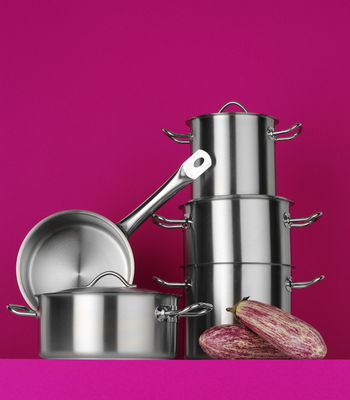
Commercial pots and pans (7)
Commercial pots and pans are essential equipment in any professional kitchen. They are used for boiling, stewing, frying, reducing sauces, preparing large batches of food, and serving dishes attractively directly in the cookware.
This category features cookware designed for restaurants, hotels, canteens, catering companies and other catering establishments. A variety of capacities, diameters and materials allow you to tailor the equipment to the type of dishes, workload and heating appliances available.
Professional catering pots
Catering pots are available in a range of heights and capacities. Smaller models are ideal for sauces, side dishes and individual portions, whilst larger pots allow for the preparation of soups, stocks, pasta, vegetables and dishes for a larger number of guests.
Depending on the application, you can choose:
- tall pots for soups, stocks and cooking large quantities of food,
- medium-sized pots for everyday kitchen tasks,
- shallow pots for stewing, reducing and preparing one-pot meals,
- saucepans for sauces, creams, side dishes and small portions,
- cast-iron pots for slow cooking, roasting and serving.
Frying pans for professional kitchens
The frying pan should be chosen to suit the type of food and the cooking technique used. Quick-frying meat requires a different pan to preparing fish, eggs, vegetables or delicate ingredients prone to sticking.
The range may include, amongst other things:
- versatile catering frying pans,
- non-stick frying pans,
- stainless steel frying pans,
- carbon steel frying pans,
- cast iron pans,
- oval fish pans,
- cookware for frying and serving food directly.
Stainless steel pots and pans
Stainless steel is often used in professional catering due to its durability, corrosion resistance and ease of cleaning. Cookware with a multi-layered or reinforced base helps to distribute heat more evenly.
Before purchasing, it is worth checking the construction of the base, how the handles are attached, whether the cookware is dishwasher-safe, and whether it is compatible with your heat source.
Cast-iron pots and pans
Cast iron retains heat for a long time, making it ideal for stewing, slow cooking, baking and serving dishes that need to be kept warm. Enamelled cookware is also available in sizes suitable for buffets or serving individual portions.
Cast iron pots and pans can be used for:
- stews and one-pot dishes,
- meat and vegetables,
- baked dishes,
- dishes served directly at the table,
- keeping food warm whilst serving.
Cast iron cookware is heavier than steel or aluminium cookware, so its weight should be taken into account when handling and storing it.
Aluminium frying pans with a non-stick coating
Aluminium conducts heat quickly and helps to reduce the weight of the cookware. The non-stick coating makes it easier to prepare delicate foods and to fry with less fat.
You should use accessories that do not damage the surface of these pans. You should not use metal utensils or abrasive scourers, unless the manufacturer of the specific model expressly permits it.
Carbon steel frying pans
Carbon steel responds well to temperature changes and can be used for intense frying and searing. Cookware of this type requires proper care and surface protection in accordance with the manufacturer’s instructions.
Regular use and proper maintenance can lead to the formation of a natural non-stick layer. After washing, the pan should be thoroughly dried to reduce the risk of corrosion.
Cookware for induction, gas and electric hobs
Not every saucepan or frying pan is compatible with all heat sources. Before purchasing, check the manufacturer’s markings and ensure that the base is suitable for the type of hob you use.
Cookware may be designed for:
- gas hobs,
- electric hobs,
- ceramic hobs,
- induction hobs,
- ovens – provided the material and design of the handles allow for this.
How do you choose the right pot capacity?
The capacity should be chosen according to the number of portions being prepared and the type of dish. The pot should provide sufficient space for stirring the ingredients, whilst not being so large that a small amount of food heats up unevenly.
When choosing, it is worth considering:
- the number of portions being prepared at the same time,
- the volume of liquids and ingredients,
- the diameter of the hob,
- the height of the available space on the hob,
- the weight of the full pot,
- the ability to nest pots one inside the other.
Lids and handles
A lid helps to minimise heat and moisture loss during cooking. It may be included with the pot or sold separately, so you should check that the diameter and series are compatible before purchasing.
Handles should provide a secure grip and be firmly attached to the body. When using the cookware intensively, always assume that metal parts may be hot and use suitable gloves or pot holders.
Pots and pans for cooking and serving
Some cookware combines cooking and presentation functions. Miniature pots, cast-iron frying pans with stands, and enamelled cookware can be used to serve starters, side dishes and one-pot meals directly on the table or at a buffet.
When using them in this way, check the safety of the trivet, the temperature of the handles and how guests are warned about the hot cookware.
How to choose catering pots and pans?
- identify the most commonly used cooking and frying techniques,
- select the material according to the type of food being prepared,
- check the diameter, height and capacity of the cookware,
- confirm compatibility with the heat source,
- pay attention to the design of the base and handles,
- check whether a lid is included in the set,
- consider whether it can be used in the oven,
- compare the washing and maintenance requirements.
Cleaning and care of cookware
Care instructions depend on the material and finish. Stainless steel, cast iron, carbon steel and non-stick surfaces require different cleaning methods.
Before first use and after any servicing, follow the manufacturer’s instructions. Do not cool a very hot pan or pan rapidly, as a large temperature difference may cause it to warp or damage the surface.
Choose catering pots and pans suited to your menu, the number of portions prepared and your kitchen equipment. The right material, capacity and base construction will help you carry out daily production efficiently and ensure consistency in your dishes.